Email: sales@hebeiseawell.com
Tel: +86 13803395277


The global shift toward sustainable home ambiance has transformed the candle from a simple utility into a sophisticated element of interior design and wellness. Today, buyers are no longer looking for just a light source; they are seeking clean-burning, non-toxic options that align with vegan and cruelty-free lifestyles.
This shift is particularly evident in the manufacturing landscape of the China household candle sector, where the transition from traditional paraffin to premium soy and beeswax represents a broader industry move toward environmental consciousness. The integration of sophisticated scent profiles—such as earthy pine and cedarwood—further reflects a growing consumer demand for olfactory experiences that evoke nature and luxury.
Understanding the technical distinctions between wax types, wick materials, and fragrance concentrations is essential for importers and homeowners alike to ensure product safety and performance.


Historically, the household candle market was dominated by paraffin wax due to its cost-effectiveness and ease of molding. However, modern manufacturing has branched into a diverse ecosystem of materials. Beeswax, for instance, is prized for its natural honey scent and air-purifying properties, while soy wax has become the standard for container candles due to its lower melting point and cleaner burn.
The specialization of production facilities often reflects these material differences. For example, specialized plants may focus exclusively on stick candles for specific regional markets, while others prioritize the complex pouring processes required for scented pillar and shaped candles.
Achieving a "clean burn" involves a precise synergy between the wax chemistry and the wick's capillary action. Metal-free cotton wicks are now preferred to avoid the release of lead or other toxins during combustion. The wick diameter must be perfectly matched to the candle's diameter to prevent "tunneling"—where the candle burns down the center, leaving a ring of unburnt wax around the edges.
From a chemical standpoint, 100% soy wax candles are inherently more sustainable as they are biodegradable and derived from renewable sources. These candles typically exhibit a slower burn rate compared to paraffin, extending the product's lifecycle. A standard 7x8cm glass container candle, for instance, can provide up to 35 hours of consistent fragrance when the wick is trimmed correctly.
Certification standards such as CE and ROHS are critical benchmarks for these products. They ensure that the materials used in the manufacturing process—including the dyes and fragrance oils—meet strict safety and environmental health guidelines, which is a non-negotiable requirement for entry into European and US markets.
The quality of a scented candle is measured by its "cold throw" (the scent when unlit) and its "hot throw" (the scent when burning). To achieve a sophisticated aroma, manufacturers utilize a layering technique, combining base, middle, and top notes.
Sophisticated home scents are moving away from singular notes toward complex, atmospheric blends. Earthy combinations of pine, smoke, cashmere, clove, and cedarwood create a sensory experience that is indulgent yet inviting, suitable for high-end residential spaces.
The concentration of fragrance oil must be carefully balanced. Too little results in a weak scent, while too much can compromise the structural integrity of the wax or cause the candle to smoke. Precision in the mixing temperature is key to ensuring the oil is fully bonded with the wax.
Different wax bases offer varying performance characteristics depending on the intended use of the candle. While paraffin is excellent for maintaining the shape of intricate shaped candles, soy wax is superior for container-based aromatic candles.
The following index illustrates the relative strengths of common waxes based on internal analysis of burn quality, scent retention, and environmental impact.
The selection of a candle depends heavily on the architectural volume and intended mood of the room. For large bedrooms and living rooms, glass container candles with high scent throws are recommended to effectively fill the space with aroma without becoming overwhelming.
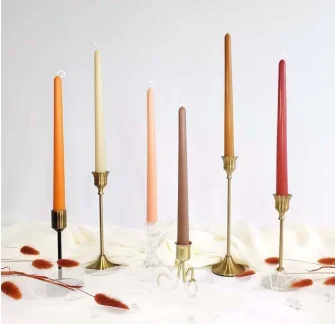
In contrast, smaller spaces like bathrooms or hallways benefit from tealight candles or small tin container candles. For formal dining settings, tapered candles remain the standard, providing elegant vertical lines and a steady flame that does not interfere with the sensory experience of the meal.
The industry is moving toward "conscious manufacturing," emphasizing vegan, cruelty-free, and paraffin-free certifications. This involves not only the wax but the entire supply chain, from the sourcing of sustainable soy to the use of recyclable glass and tin containers.
Technological advancements in pouring processes are also reducing waste. Large-scale facilities are increasingly implementing precision temperature controls to minimize wax scrap and improve the consistency of the burn across thousands of units.
Furthermore, the integration of "wellness" scents—those designed to reduce stress or improve focus—is expected to grow. The focus is shifting from simple fragrance to a holistic approach where the candle serves as a tool for mental well-being.
For businesses sourcing China household candle products in bulk, the evaluation process should extend beyond price. The capability of the manufacturer to maintain consistent quality across large monthly outputs—such as 180 containers—is a primary indicator of reliability.
Compliance with international labor and safety standards, including BSCI and NBC Universal audits, provides a necessary layer of risk management for global brands. These certifications ensure that the production environment is ethical and the quality control systems are robust.
The following table provides a comparative framework for selecting the right candle type based on common market requirements and application scenarios.
| Candle Type | Primary Material | Best Application | Key Selection Factor |
|---|---|---|---|
| Scented Glass | 100% Soy Wax | Large Living Rooms | Scent Throw/Burn Time |
| Tapered/Stick | Paraffin/Beeswax | Dining/Events | Drip Control/Straightness |
| Pillar Candles | Beeswax/Paraffin | Home Decor/Accents | Shape Stability/Color |
| Tealights | Paraffin/Soy Mix | Small Accents/Warmers | Consistency/Cost-per-Unit |
| Tin Containers | Soy/Paraffin Blend | Travel/Small Gifts | Packaging Portability |
| Shaped Candles | Paraffin/Specialty | Giftware/Art | Detail Precision/Mold Quality |
Soy wax is derived from soybeans, making it renewable, biodegradable, and generally cleaner-burning with less soot. It typically has a lower melting point, which allows fragrance oils to be released more slowly and consistently. Paraffin wax, a byproduct of petroleum, is more cost-effective and provides a stronger scent throw, but it is not renewable and may produce more soot if the wick is not perfectly maintained.
Tunneling occurs when the wax does not melt all the way to the edge of the container. To prevent this, always allow the candle to burn until the entire top layer of wax has melted into a liquid pool during the first few uses. Additionally, keep the wick trimmed to about 1/4 inch (6mm) to ensure a controlled flame that distributes heat evenly across the wax surface.
For high-traffic, large-volume areas like hotel lobbies, luxury glass container candles using premium soy wax are ideal. They provide a sophisticated aesthetic and a consistent, long-lasting fragrance (hot throw) that can fill a large space. Scent profiles with woody or earthy notes, such as cedarwood and pine, are often chosen to create an inviting, professional, and luxurious atmosphere.
Key certifications include CE and ROHS, which ensure the products meet safety and environmental standards for the EU market. For ethical manufacturing, look for BSCI (Business Social Compliance Initiative) certification. These documents verify that the factory follows fair labor practices and uses materials that are safe for the end consumer, reducing legal and reputational risks for the importer.
Beeswax is a natural byproduct of honey production and is completely biodegradable. Unlike paraffin, it does not release petroleum-based chemicals into the air. Some studies suggest that beeswax candles can actually help neutralize pollutants in the air by releasing negative ions. However, they are more expensive to produce and have a distinct natural honey scent that may interfere with added fragrances.
Wick material determines the rate of wax consumption and the cleanliness of the flame. Metal-core wicks (containing lead or zinc) were common but are now avoided due to toxicity. Pure cotton or paper-core wicks provide a cleaner burn. The weave and thickness of the cotton must be calibrated to the wax type; for instance, soy wax requires a different wick structure than paraffin to maintain a steady flame without flickering.
The evolution of the home candle industry highlights a broader consumer movement toward sustainability, health, and intentional living. As materials shift toward soy and beeswax and scent profiles become more complex, the value of a candle is now defined by its ability to enhance a space both visually and emotionally.
For those seeking to integrate these products into their homes or business portfolios, focusing on the synergy between material purity, technical execution, and certified manufacturing ensures a product that is not only luxurious but safe and sustainable for the long term.